
|
 |
 |
 |
 |
 |
 |
 |
 |
 |
 |
 |
| | | |  |  |
| |
| |
 | Visit the Sons de Mar stand at the Barcelona World Race! |
|
|
 |
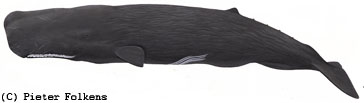
SPERM WHALE (Physeter macrocephalus)
|
|
|
The sperm whale is the largest toothed (as opposed to baleen whales) cetacean in the world. The males can grow up to 18 m in length (57 tonnes), while females do not exceed 11 m (24 tonnes).
Distribution
Their distribution is cosmopolitan. Males can be found from the Artic to the Antarctic oceans, but the females and calves remain in warmer waters (40º S - 40º N). They normally feed on squid, measuring from a few cm up to 10 meters, but they also eat octopuses and demersal fish. It is estimated that an adult male can ingest up to 1 tonne of food per day. Their foraging dives can be deep, 500 - 700 m, and last 40 minutes on average, although dives of over 90 minutes at more than 2000 m depth have been described.
|
|

|
|
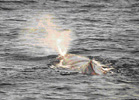
Sperm whale breathing at the surface.
|
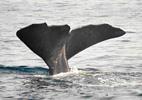
Sequence of movements of a sperm whale before a dive.
|
|
|
Biological Cycle
Females reach sexual maturity after 13 years and the males after 15 to 20 years, although they are not social adults and do not reproduce until they reach 25 - 30 years. During this interval the males leave their family and join other young adults that have the same status until they can compete with the reproducing males.
Mating usually occurs in winter in tropical waters. After 14 - 15 months one young is born, measuring 3.5 - 4 m and weighing 500 - 1000 kg. Lactation normally lasts one to two years, and the period between births is usually three to five years.
It is believed that sperm whales have a life expectancy of 60 - 70 years.
Acoustic Signals
The sperm whale's head can represent more than 30% of the animal's weight and more than ¼ of its total length (which is the origin of its Latin name macrocephalus). Inside, one finds a large chamber that holds the spermaceti organ, which is formed by a special wax which function is related to the production and amplification of sounds for its echolocation use, its biological sonar system.
The sperm whale's sonar system is one of the most powerful among cetaceans. It includes the emission of pulsed sounds, named "clicks", which energy is distributed in an acoustic window that extends from a few Hz up to 30 kHz with an intensity that exceeds 230 dB re 1 uPa at 1 m (equivalent to the intensity of noise produced by an airplane concentrated in milliseconds). Nevertheless, the most important part of the signal is concentrated around 15 kHz in a highly directional beam that is used to detect their preys. Recent data suggests that a single click allows a sperm whale to localise a 25 cm squid at a two kilometre distance.
The sperm whale is one of the oldest of the current cetaceans and it evolved into its current shape more than 25 million years ago. Certainly, this is the reason that its phonation system is the most complex one, but paradoxically the acoustic signals that are produced contain very simple physical characteristics that have a double function: communication at large distances and echo localisation.
The sperm whale produces different types of clicks:
|
Flash
|
"usual clicks": these are produced during the entire dive and represent 80% of all the acoustic emissions. It has been shown that their properties are largely comparable with vision. Apart from this function, the combination of the individual click sequences guarantees coherence in a social group and optimisation of the search for food. The mechanism of vocal communication in this species resembles those that govern the transmission of percussive information (through drums) of tribes in Senegal.
|
|
Flash
|
"creaks": these are very rapid succession of clicks. They can be considered complimentary to the usual clicks in the echo localisation process, permitting a detailed analysis of the environment at a short distance.
|
|
Flash
|
"codas": these are short rhythmic patterns of a few clicks repeated several times. Since they are only observed in areas where social groups (females, males and calves) reside, it is believed that the codas serve some communicative role.
|
|
|
Click the images with the left button to listen to the signals.
|
|
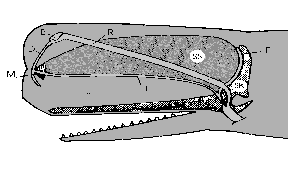
Sperm Whale Acoustic Production
|
|
- B: Blowhole
- M: Museau de singe
- R: Right nare
- L: Left nare
- F: Frontal Sac
- D: Distal sac
- SS: Spermaceti
- SK: Skull
- J: Junk
|
|
|
Air enters the blowhole by controlled breathing. While most of it is passed through the trachea, directed towards the lungs, a considerable volume is used to fill the frontal sac, literally an air-sac, through the right nare. Sphincter muscles drive the air through the Museau de singe by the left nare, which enables the production of a pulsed sound named click. Due to the presence of the other air sac, the distal sac, placed just in front of the Museau de singe, the click is reflected backward and it propagates through the spermaceti. A second reflection against the frontal sac sends the click forward again, amplifying the sound and focussing it by the passage through the greasy masses of the junk, to the outside medium. This entire process only takes a few milliseconds and repeats itself rhythmically until there is no more air in the frontal sac. A recycling process allows the acoustic production to continue indefinitely, sending air in the distal sac back through the right nare passage to the frontal sac.
Sperm whales and acoustic contamination
Since the beginning of the 18th century until 1985 (and 1988 in Japan), the main threat to this species was large scale hunting for the oil that was extracted from the spermaceti organ.
Today, its hunt is forbidden in all countries; however there still are a number of threats left, like collisions with ships, chemical and/or inorganic pollution, and especially acoustic contamination.
Sperm whales live in stable social groups, which cohesion is based on acoustic communication between the individuals that form it (normally between 15 - 20 animals). Their acoustic signals can propagate up to 10 to 15 km, depending on the sea state. All members of the same group distribute themselves especially as a function of this distance in order to cover a large hunting area without losing acoustic contact: each one has to be able to hear and analyse the information emitted by the member furthest away. Any artificial sound source that can interfere with their acoustic exchanges would reduce the distance between the members, as well as the probability of encountering their prey. Unfortunately, most contaminating acoustic sources produced by man coincide with the frequency range produced by sperm whales and in some regions it has been possible to observe a loss of their auditory sensitivity, which was directly associated with the increase in the number of collisions with shipping traffic.
The fundamental role of this species in the food chain sees itself threatened here: the displacement from a certain area or the extinction of a population would correspond with a general and irreversible imbalance in the whole ecosystem, as it would imply the uncontrolled multiplication of its prey (squids) at a rate of one tonne of preys per day and per lost sperm whale.
Beyond the continuous interruption of their vital activities, to value the real impact of acoustic pollution on the sperm whales, and on other cetaceans in general, as well as the traumas that it creates, is no trivial task. It requires a continuous investigative effort, the combination of many scientific disciplines and the active participation of the society in order to make, with its collaboration, the conservation of cetaceans an obligatory step and to return the sea to its natural balance.
|
|
|
| Images |
|
|
